Did you know that when you use electricity can be just as important as how much you use? FESCO, like all NEPRA-regulated electricity distribution companies in Pakistan, uses a Time-of-Use (ToU) pricing system for certain consumer categories — where electricity costs more during peak hours and less during off-peak hours.
Understanding FESCO peak hours timing can help you significantly reduce your monthly electricity bill by shifting heavy appliance usage to off-peak periods. After reading this guide, you can check your current FESCO bill online to see how your usage patterns are affecting your charges, or estimate the impact of your usage with our FESCO bill calculator.
Peak Hours
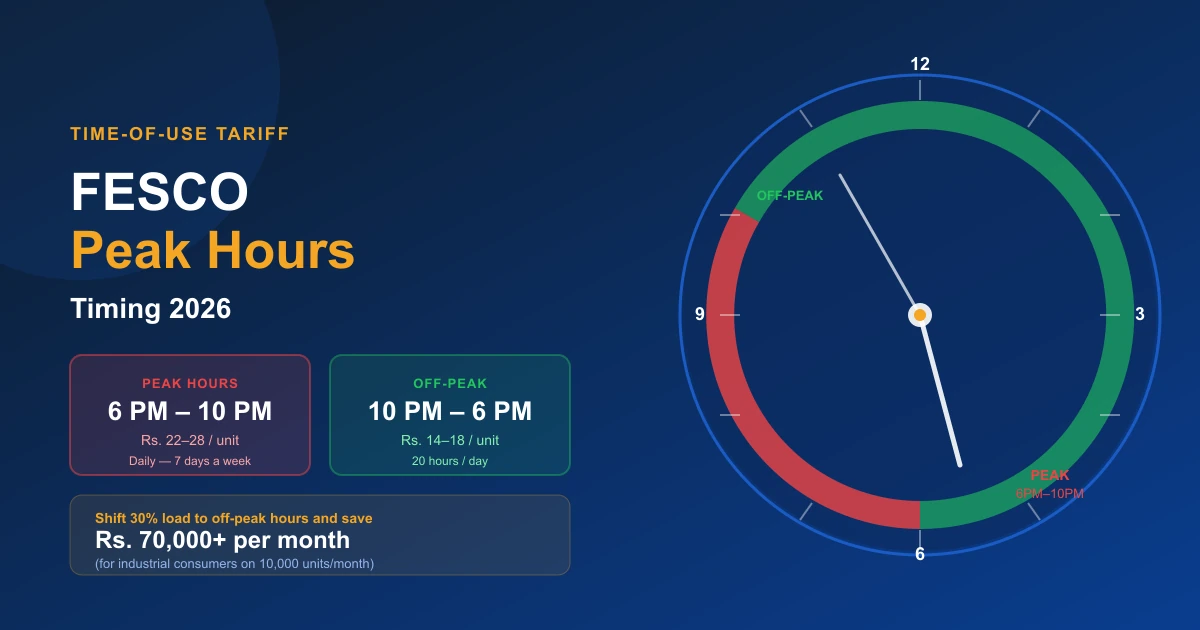
6:00 PM – 10:00 PM Daily
Off-Peak Hours
10:00 PM – 6:00 PM Daily
ToU Applies To
70 kW+ Industrial Load
Peak vs Off-Peak Difference
Rs. 5–10 per unit
What Are FESCO Peak Hours?
Peak hours are specific time periods during the day when the demand for electricity is at its highest. During these hours, the cost of generating and distributing electricity is more expensive, so NEPRA allows distribution companies like FESCO to charge a higher per-unit rate to consumers who fall under the Time-of-Use (ToU) tariff.
Off-peak hours are the remaining periods when electricity demand is lower, and the per-unit rate is significantly cheaper.
The purpose of peak-hour pricing is to:
- Reduce the load on the national electricity grid during high-demand periods
- Encourage consumers to shift energy usage to off-peak times
- Reduce the need for expensive emergency power generation
- Lower the overall cost of electricity for consumers who adapt their usage
FESCO Peak Hours Timing (2026)
According to NEPRA's approved Time-of-Use tariff schedule:
Peak Hours
6:00 PM to 10:00 PM (18:00 – 22:00) — daily, 7 days a week
These 4 hours represent the highest electricity demand period in Pakistan. Most families return home, cook dinner, use air conditioners, and power up televisions and other appliances simultaneously — creating the largest strain on the grid.
Off-Peak Hours
10:00 PM to 6:00 PM (22:00 – 18:00) — the remaining 20 hours each day
Off-peak hours include:
- Late night (10:00 PM to midnight)
- Early morning (midnight to 6:00 AM)
- Morning hours (6:00 AM to 12:00 PM)
- Afternoon hours (12:00 PM to 6:00 PM)
Weekend and Public Holiday Pricing
For many industrial and commercial ToU tariff consumers, Sundays and public holidays are considered off-peak all day, providing additional savings opportunities for businesses that can shift operations.
ℹ️ Timings May Be Revised
Peak and off-peak hour schedules are set by NEPRA and may be revised periodically. Always check the latest NEPRA tariff notification for current timings.
Who Is Affected by FESCO Peak Hour Pricing?
The Time-of-Use tariff is not applicable to all consumers. Understanding which category you fall under is important.
Industrial Consumers (Most Affected)
Large industrial consumers with a sanctioned load of 70 kW or above are typically placed under the ToU (Time-of-Use) tariff. This includes:
- Factories and manufacturing units
- Textile mills and processing plants
- Industrial complexes and production facilities
For these consumers, the difference between peak and off-peak rates can be Rs. 5 to Rs. 10 per unit — making load-shifting a significant cost-saving strategy.
Commercial Consumers
Large commercial consumers above a certain load threshold may also be eligible for or required to use the ToU tariff, including:
- Large shopping malls and retail complexes
- Hotels and large restaurants
- Commercial buildings with high sanctioned loads
Residential Consumers
ℹ️ Most Home Consumers Are Not on ToU Tariff
Most residential (domestic) consumers in FESCO's service area are not on the Time-of-Use tariff and pay the same rate regardless of when they use electricity. However, understanding peak hours still helps with reducing grid pressure, preparing for any future ToU expansion to domestic consumers, and building good energy conservation habits.
FESCO ToU Tariff Rates — Peak vs Off-Peak (2026)
NEPRA sets different rates for peak and off-peak consumption under the ToU tariff. The approximate rates for industrial consumers are:
| Period | Rate (Approx.) |
|---|---|
| Peak Hours (6 PM – 10 PM) | Rs. 22–28 per unit |
| Off-Peak Hours (10 PM – 6 PM) | Rs. 14–18 per unit |
ℹ️ Additional Charges Apply on Top of ToU Rates
These are approximate NEPRA-approved rates. Actual rates include additional charges such as GST (17%), FPA, FC Surcharge, and QTA. To understand all the components of your bill, read our complete FESCO bill taxes guide.
The savings from shifting usage to off-peak hours can be substantial. A factory consuming 10,000 units per month, shifting even 30% of load from peak to off-peak hours, could save Rs. 30,000–50,000 per month.
How the Time-of-Use Meter Works
To benefit from peak/off-peak pricing, a consumer must have a ToU (Time-of-Use) energy meter installed at their premises. This is different from a standard electricity meter:
Standard Meter
- Records only total units consumed
- Charges the same rate for all consumption
- Cannot distinguish between peak and off-peak usage
ToU Meter
- Records consumption separately for peak and off-peak periods
- Has an internal clock that tracks time and date
- Prints separate peak and off-peak unit totals on your bill
- Allows you to be billed at different rates for different periods
FESCO provides ToU meters to qualifying industrial and commercial consumers as part of the connection setup or meter upgrade process.
How to Read Your FESCO ToU Bill
If you are on the Time-of-Use tariff, your FESCO bill will show two separate unit readings:
- Peak Units (PE): Units consumed during 6 PM – 10 PM
- Off-Peak Units (OPE): Units consumed during 10 PM – 6 PM
Each is multiplied by its respective rate. The total energy charge is the sum of both. All other charges (FPA, GST, Fixed Charges, FC Surcharge, QTA, etc.) are then applied to this combined total.
To view your duplicate bill with all these charges broken down, enter your 14-digit Reference Number on our bill check tool.
Practical Ways to Save Money Using FESCO Off-Peak Hours
Whether you are a residential, commercial, or industrial consumer, here are effective strategies to reduce your electricity bill by using off-peak hours:
For Industrial Consumers
1. Shift Production Schedules to Night Hours
Move energy-intensive operations — machinery, heavy equipment, compressors, furnaces — to off-peak hours (10 PM to 6 PM). A single shift change can save tens of thousands of rupees per month.
2. Schedule High-Load Machinery for Off-Peak
Plan maintenance, cleaning, and heavy-load operations during the cheapest hours. Machinery warm-up and cool-down cycles can also be timed for off-peak periods.
3. Pre-Cool or Pre-Heat Facilities
Use industrial HVAC systems during off-peak hours to pre-cool or pre-heat large spaces, reducing the need to run at full power during expensive peak hours.
4. Install Energy Storage Systems
Advanced industrial consumers can install battery storage systems that charge during off-peak hours and discharge during peak hours — effectively eliminating peak usage and dramatically reducing bills.
For Commercial Consumers
1. Schedule Lighting and HVAC Maintenance
Set programmable thermostats and lighting timers to reduce consumption between 6 PM and 10 PM.
2. Avoid Running High-Load Equipment During Peak Hours
Commercial kitchens, laundries, data centers, and other high-consumption equipment should be scheduled outside peak hours where operationally possible.
3. Use Smart Power Meters and Energy Management Systems
Install energy management software that tracks peak vs off-peak consumption in real-time and alerts you when you approach peak pricing windows.
For Residential Consumers
Even though most residential FESCO consumers are not on the ToU tariff, developing good energy habits helps reduce grid pressure and prepares you for any future tariff changes:
1. Run Heavy Appliances at Night or in the Morning
- Washing machines and dryers: Run after 10 PM or early morning
- Electric water heaters (geysers): Set timers to heat water before 6 AM
- Dishwashers: Run overnight
2. Charge Devices During Off-Peak Hours
Phones, laptops, electric vehicles, and batteries should ideally be charged between 10 PM and 6 AM.
3. Use Energy-Efficient Appliances
Inverter ACs, LED lights, and 5-star energy-rated appliances consume significantly less electricity, reducing your bill regardless of peak or off-peak timing.
4. Monitor Your Monthly Consumption
Keep your monthly units below the 200-unit protected consumer threshold (if possible) to maintain lower tariff rates. Read our FESCO bill check guide to monitor your consumption each month.
FESCO Load Shedding and Peak Hours — The Connection
Pakistan's load shedding (scheduled power outages) is directly related to peak hour demand. When too many consumers use heavy loads simultaneously during peak hours (6–10 PM), the grid becomes overloaded and FESCO is forced to implement load shedding.
By shifting usage to off-peak hours, consumers collectively:
- Reduce the need for expensive emergency power generation
- Help FESCO distribute electricity more efficiently
- Decrease the frequency and duration of load shedding in their area
- Support the national grid stability
This is one reason why NEPRA actively promotes ToU pricing — it is a market mechanism to balance grid load without physical rationing.
How to Apply for a ToU Meter from FESCO
If your business is eligible for or interested in switching to the Time-of-Use tariff, you can:
Apply Through the FESCO ENC System
Use the same ENC portal used for new connections to submit a meter change application online.
Submit a Meter Change Application at Your Sub-Division
Alternatively, visit your nearest FESCO Sub-Division office and submit a meter change application in person.
FESCO Assesses Your Load and Eligibility
FESCO will review your current sanctioned load to confirm you meet the eligibility criteria for the ToU tariff.
ToU Meter Is Installed
If eligible, a Time-of-Use meter will be installed at your premises and your account will be migrated to the ToU tariff.
For a complete guide on the FESCO application process, see our FESCO New Connection Application guide.
Impact of Peak Hours on Your FESCO Bill — Real Example
Real Savings Calculation: Small Industrial Consumer, 10,000 units/month
Without Load Shifting (all at peak hours):
- Peak units: 10,000 × Rs. 26 = Rs. 260,000
With Load Shifting (70% off-peak, 30% peak):
- Peak units: 3,000 × Rs. 26 = Rs. 78,000
- Off-peak units: 7,000 × Rs. 16 = Rs. 112,000
- Total: Rs. 190,000
Monthly savings: Rs. 70,000 — just by timing when electricity is used.
This shows why understanding FESCO peak hours is so important for industrial and commercial consumers.
Summary of FESCO Peak and Off-Peak Hours
| Category | Timing | Rate |
|---|---|---|
| Peak Hours | 6:00 PM – 10:00 PM (daily) | Higher rate |
| Off-Peak Hours | 10:00 PM – 6:00 PM (daily) | Lower rate |
| Weekend / Holidays | All day (for some categories) | Off-peak rate |
Frequently Asked Questions
What Are the Peak Hours for FESCO Electricity?
FESCO peak hours are from 6:00 PM to 10:00 PM daily. These are the highest-demand hours when electricity rates are at their most expensive under the ToU tariff.
Do Peak Hours Apply to Residential Consumers?
Most residential (domestic) consumers in FESCO's area pay a flat rate regardless of time and are not subject to ToU pricing. The peak/off-peak tariff primarily applies to industrial and large commercial consumers.
How Can I Check If I Am on a ToU Tariff?
Check your bill by reference number — if it shows separate readings for peak and off-peak units, you are on the ToU tariff. Alternatively, call FESCO helpline at 111-000-118 to confirm your tariff category.
Can I Request to Switch to the ToU Tariff?
Industrial consumers meeting NEPRA's eligibility criteria can request ToU metering from FESCO. Contact your nearest FESCO Sub-Division office or apply through the FESCO ENC system.
Does FESCO Have Different Rates for Summer and Winter?
NEPRA may revise tariff rates seasonally or through periodic notifications. Check your bill or the NEPRA website for the most current approved rates.
What Is the Cheapest Time to Use Electricity in Pakistan?
The cheapest time to use electricity under FESCO's ToU tariff is during off-peak hours — from 10:00 PM to 6:00 PM the following day. Late night (10 PM to 6 AM) offers the best rates and usually the most stable grid supply.
How Do I Reduce My FESCO Bill?
Key strategies include:
- Shift heavy appliance usage to off-peak hours (10 PM – 6 PM)
- Stay within the 200-unit protected consumer threshold if possible
- Use energy-efficient inverter appliances
- Become a tax filer to reduce withholding tax
- Pay before the due date to avoid late surcharges
- Check your FESCO bill online every month to monitor consumption trends
Conclusion
Understanding FESCO peak hours timing gives you a genuine opportunity to reduce your electricity bills — especially if you are an industrial or commercial consumer on the Time-of-Use tariff. The difference between peak and off-peak rates is significant, and smart load shifting can result in substantial monthly savings.
For residential consumers, developing off-peak habits helps reduce national grid pressure and positions you for any future expansion of time-of-use pricing to domestic consumers.
Start by checking your current FESCO bill online to understand your current consumption patterns and charges.
Related Guides
- Check FESCO Bill by Reference Number Online
- FESCO Bill Taxes Explained — GST, FPA & All Charges
- FESCO Duplicate Bill — Download & Print Free
- FESCO New Connection Application — ENC Online Guide
- FESCO Bill Complaint Online — File & Track Easily
- How to Change Name on Electricity Bill in Pakistan
- FESCO Bill Calculator — Estimate Your Bill Free
- FESCO Online Bill Check — Homepage

Shahzad Mahmood
Sub-Divisional Officer (SDO), FESCO
Shahzad Mahmood is a Sub-Divisional Officer (SDO) at Faisalabad Electric Supply Company (FESCO) with hands-on experience in electricity distribution, metering, and consumer billing. He reviews the guides on this site to keep the bill-checking steps, tariffs, and complaint procedures accurate and up to date.
View LinkedIn Profile