Many people are surprised when their Faisalabad Electric Supply Company bill is much higher than the cost of the electricity units they actually used. This happens because several taxes, duties, and extra charges are added to every electricity bill — collected for the government and NEPRA.
Understanding these taxes helps you check your bill correctly, avoid confusion, and manage your monthly electricity expenses better. After reading this guide, you can verify your own bill instantly at fesco-online-bill-check.pk.
GST Rate
17% of electricity cost
FC Surcharge
Rs. 0.43 per unit
PTV Fee
Rs. 35/month (fixed)
Lifeline Consumer
50 units or fewer/month
How Is a FESCO Electricity Bill Structured?
A normal FESCO electricity bill has two main parts:
- Electricity cost — based on the number of units you use
- Extra taxes and charges — added by the government and other authorities
Because of these extra charges, two homes using the same number of units may still receive different bill amounts.
Your total bill is usually made up of:
- Electricity unit charges
- Fuel Price Adjustment (FPA)
- Fixed charges and meter rent
- General Sales Tax (GST)
- Electricity Duty (ED)
- Income Tax (Withholding Tax)
- FC Surcharge (Financial Cost Surcharge)
- Quarterly Tariff Adjustment (QTA)
- PTV fee (Rs. 35/month)
- Neelum-Jhelum Surcharge
- Extra taxes for some commercial users
- Government subsidy (if applicable)
All these charges are added together to calculate the final payable amount on your bill. To view your current bill with all charges broken down, use our FESCO bill check tool. You can also download your duplicate bill to see the full tax breakdown.
FESCO Bill Taxes and Charges — Complete Summary Table (2026)
| Tax / Charge | Full Name | Rate / Amount | Who Pays | Refundable? |
|---|---|---|---|---|
| GST | General Sales Tax | 17% of electricity cost | All consumers | No |
| Income Tax (IT) | Withholding Tax | Depends on bill amount and filer status | Bills above Rs. 25,000 | Yes (tax filers) |
| Electricity Duty (ED) | Provincial Electricity Duty | ~1.5% of electricity cost | All consumers | No |
| FPA | Fuel Price Adjustment | Changes every month | Most consumers | No |
| FC Surcharge | Financial Cost Surcharge | Rs. 0.43 per unit | Most consumers | No |
| QTA | Quarterly Tariff Adjustment | ~Rs. 2.74–2.75 per unit | Non-lifeline consumers | No |
| Fixed Charges | Meter and connection charges | Rs. 75–350 per month | All consumers | No |
| TV Fee | PTV License Fee | Rs. 35 per month | Most home users | No |
| Meter Rent | Meter rental charges | Rs. 20–25 per month | Consumers using FESCO meter | No |
| Further Tax | Extra tax under Sales Tax law | 4% | Unregistered commercial users | No |
| Extra Tax | Extra Sales Tax | 3%–5% | Some unregistered commercial users | No |
| NJ Surcharge | Neelum-Jhelum Surcharge | Small per-unit charge | Most consumers | No |
FESCO Tariff Slabs — How Your Unit Rate Is Determined
Before taxes are added, FESCO calculates your bill based on the number of electricity units you use. The more units you consume, the higher your per-unit rate becomes. This is called the tariff slab system.
Because of this system, even a small increase in units can significantly raise your bill.
What Is a Protected Consumer?
A protected consumer is a home user who has used 200 units or fewer each month for the last 6 months. Protected consumers get lower electricity rates, and some extra charges may not apply to them.
⚠️ Losing Protected Status
If you use more than 200 units in any month, you may lose your protected status and be charged at significantly higher rates.
What Is a Lifeline Consumer?
A lifeline consumer is someone who uses 50 units or fewer per month. These consumers get the lowest electricity rates and are exempt from some extra charges, including:
- Fuel Price Adjustment (FPA)
- FC Surcharge
- Quarterly Tariff Adjustment (QTA)
This relief is given to help low-income families.
FESCO Residential and Commercial Tariff Slabs (2026)
| Units Consumed | Rate (PKR per Unit) | Consumer Type | Notes |
|---|---|---|---|
| 1 – 50 | Rs. 3.95 | Lifeline / Protected | Lowest rate |
| 51 – 100 | Rs. 7.74 | Protected Domestic | Lower tariff |
| 1 – 100 | Rs. 10.54 | Non-Protected Domestic | Higher rate |
| 101 – 200 | Rs. 16 approx | Domestic | Standard slab |
| 201 – 300 | Rs. 19 approx | Domestic | Bill increases more |
| 301 – 700 | Rs. 22 approx | Domestic | Higher slab |
| Above 700 | Rs. 24 approx | Domestic | Highest rate |
| Up to 25 kW load | Rs. 16.62 – 16.83 | Commercial (B-1) | Commercial tariff |
| Above 25 kW load | Rs. 18.23 – 18.44 | Commercial (B-2) | Higher commercial tariff |
ℹ️ Rates May Change
These are estimated NEPRA-approved rates. Actual rates may change. Check your current FESCO bill online for exact figures, or use our FESCO bill calculator to estimate your total — slabs, taxes, and all — before the bill arrives.
GST on FESCO Bill — General Sales Tax Explained
What Is GST on an Electricity Bill?
GST stands for General Sales Tax. It is levied under the Sales Tax Act 1990 and charged on the supply of electricity as a service. On your FESCO bill, GST is calculated at 17% of the electricity cost (including FPA). This is one of the largest taxes on your bill, collected by FESCO and deposited with the Federal Board of Revenue (FBR).
- Rate: 17% of electricity charges (including FPA component)
- Who pays: All consumers — domestic, commercial, and industrial
- Administered by: Federal Board of Revenue (FBR) under the Sales Tax Act 1990
- Where to see it: Labeled as "GST" on your FESCO bill
Is GST Applied to FPA Too?
Yes. GST is also charged on the Fuel Price Adjustment (FPA) amount. If your FPA is positive (you are being charged more due to fuel costs), you pay 17% GST on that FPA amount as well. If FPA is negative (a refund month), the GST on FPA is also credited back.
Income Tax on FESCO Bill — Withholding Tax Under Section 235
Income tax on your electricity bill is a withholding tax collected under Section 235 of the Income Tax Ordinance 2001. It is charged on monthly electricity bills above a fixed limit. FESCO collects this tax and sends it to the government.
Who Pays Income Tax on a FESCO Bill?
Income tax applies when your monthly bill is more than Rs. 25,000.
- Tax filers: Pay a lower rate and can adjust it on their tax return
- Non-filers: Pay a higher rate as a penalty
Becoming a tax filer helps you reduce this charge and save money.
Income Tax Reference Table (2026)
| Monthly Bill Amount | Tax Filer Rate | Non-Filer Rate |
|---|---|---|
| Below Rs. 25,000 | 0% | 0% |
| Rs. 25,001 – Rs. 50,000 | Low rate on extra amount | Higher rate |
| Rs. 50,001 – Rs. 200,000 | Higher slab | Almost double rate |
| Above Rs. 200,000 | Highest slab | Double rate |
You can find this charge on your bill under "Income Tax" or "IT."
Electricity Duty (ED) on FESCO Bill
What Is Electricity Duty?
Electricity Duty is a provincial tax levied under the Punjab Electricity Duty Act. It is charged at 1.5% of the cost of electricity (excluding taxes). This duty is collected by FESCO and deposited with the Punjab Government. It appears as "ED" or "Electricity Duty" on your bill.
- Rate: 1.5% of electricity cost
- Authority: Punjab Government (provincial tax)
- Who pays: All consumers in Punjab served by FESCO
Fuel Price Adjustment (FPA) on FESCO Bill
What Is FPA?
FPA stands for Fuel Price Adjustment. Pakistan generates a significant share of electricity using thermal plants that run on furnace oil and natural gas. The price of these fuels fluctuates monthly. FPA is the mechanism used to pass those fuel cost changes on to consumers — or refund savings when fuel costs drop.
- Positive FPA: Fuel costs are higher than the reference rate → you pay extra
- Negative FPA: Fuel costs are lower → you receive a credit/refund
How Often Does FPA Change?
FPA is calculated monthly by NEPRA based on actual generation costs of the previous month. It is then applied to your bill with a 2 to 3-month lag. This is why your bill may suddenly be higher or lower in a given month, even though your consumption remained the same.
ℹ️ FPA and Lifeline Consumers
Consumers using 50 units or fewer per month are exempt from FPA charges. FPA is labeled as "FPA" or "Fuel Price" on your FESCO bill.
FC Surcharge (Financial Cost Surcharge) on FESCO Bill
What Is FC Surcharge?
FC Surcharge stands for Financial Cost Surcharge. It is charged at a flat rate of Rs. 0.43 per unit of electricity consumed. The purpose of this surcharge is to help cover the debt servicing costs of Power Holding Private Limited (PHPL), which manages the circular debt in Pakistan's electricity sector.
- Rate: Rs. 0.43 per unit (kWh)
- Exemption: Lifeline consumers (up to 50 units/month)
- Purpose: Debt servicing for Power Holding Private Limited (PHPL)
Quarterly Tariff Adjustment (QTA) on FESCO Bill
The Quarterly Tariff Adjustment (QTA) is a charge designed to cover the financial gap between NEPRA's approved tariff and the actual cost of power generation and distribution. The typical QTA rate is approximately Rs. 2.74 to Rs. 2.75 per unit, revised quarterly.
- Rate: Approximately Rs. 2.74–2.75 per unit (revised quarterly)
- Exemption: Lifeline consumers (50 units or fewer per month)
- Frequency: Applied every quarter based on NEPRA notification
TV Fee (PTV License Fee) on FESCO Bill
The TV Fee (also called the PTV License Fee) is a fixed monthly charge of Rs. 35 collected on behalf of Pakistan Television Corporation (PTV). It was introduced to fund public broadcasting and is added to electricity bills as a collection mechanism.
- Rate: Rs. 35/month for most domestic consumers
- Collected by: FESCO on behalf of PTV / PEMRA
- Can it be removed? No — it is a mandatory legal charge
Meter Rent and Fixed Charges on FESCO Bill
What Are Fixed Charges?
Fixed charges are a monthly minimum charge applicable to all consumers even if they consume zero units of electricity. These charges cover infrastructure and connection maintenance costs.
Typical fixed charges:
- Single Phase Connection (domestic A-1): Rs. 75 per month
- Three Phase Connection (domestic): Rs. 150 per month
- Single Phase (commercial B-1): Rs. 175 per month
- Three Phase (commercial B-2): Rs. 350 per month
What Is Meter Rent?
Meter Rent is a small fixed monthly charge (approximately Rs. 20 to Rs. 25 for domestic meters) for the electricity meter installed at your premises by FESCO.
Neelum-Jhelum (NJ) Surcharge on FESCO Bill
The Neelum-Jhelum Surcharge is a per-unit charge applied to fund the repayment of loans taken for constructing the Neelum-Jhelum Hydropower Project in Azad Kashmir. This surcharge applies across most consumer categories.
Further Tax and Extra Tax on FESCO Bill — For Commercial Consumers
What Is Further Tax?
Further Tax is charged at 4% under the Sales Tax Act and applies when electricity is supplied to a consumer who is not registered for Sales Tax with the FBR. This commonly affects commercial and business consumers.
- Rate: 4% on the taxable value of electricity supply
- Who pays: Unregistered commercial/business consumers
- How to avoid: Register your business for Sales Tax on the FBR IRIS portal
What Is Extra Tax?
Extra Tax is an additional sales tax charge of 3% to 5% levied when a commercial electricity meter is being used by an unregistered business entity.
- Rate: 3%–5% depending on consumer category
- How to avoid: Register for Sales Tax with FBR
⚠️ High Cost for Unregistered Large Businesses
For large commercial consumers with monthly bills of Rs. 1,000,000 or more, Further Tax alone can amount to Rs. 40,000 per month — making FBR registration a financially significant step.
Government Subsidies on FESCO Bills
The Government of Pakistan provides electricity subsidies to certain consumer categories:
- Lifeline consumers (up to 50 units per month) — receive the most significant subsidy
- Protected domestic consumers (up to 200 units per month in some periods)
- Agricultural consumers (Tariff K-1 and K-2 for tube wells and farming)
Subsidies are funded through the Federal Government budget and the Inter-DISCO Tariff Rationalization (IDTR) Surcharge system managed by NEPRA. It may appear on your bill as "TR Surcharge" or "QTA."
FESCO Bill Calculation Example — Step by Step
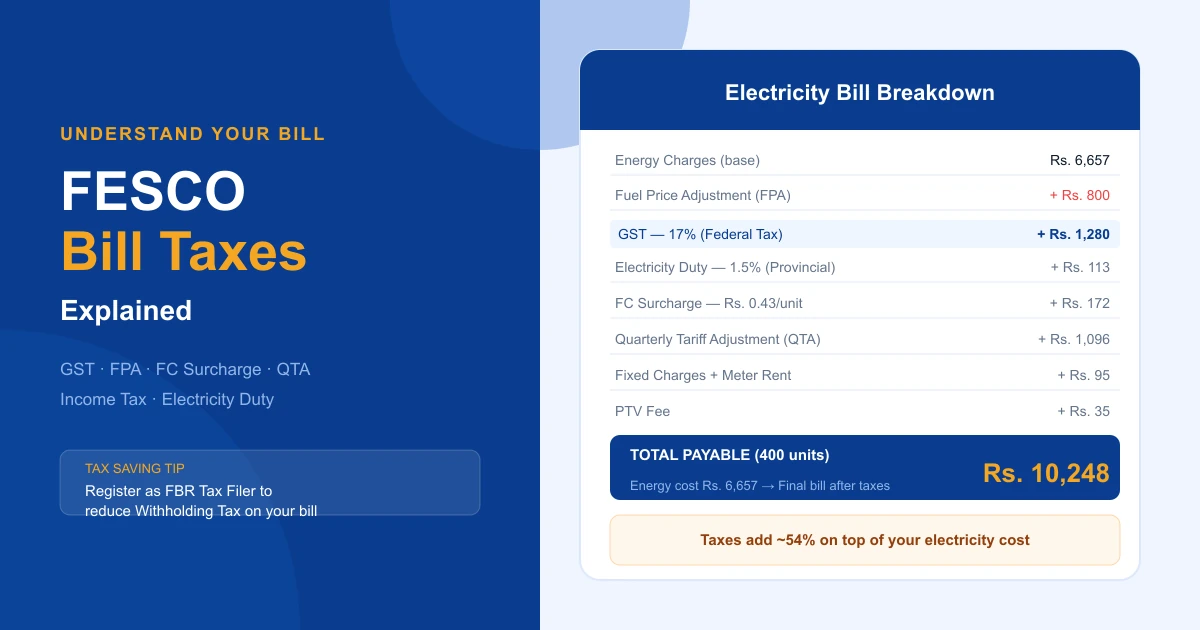
Real Calculation: Domestic Consumer Using 400 Units (Non-Protected)
| Component | Amount |
|---|---|
| Electricity cost (base) | Rs. 6,657 |
| FPA (Fuel Adjustment) | Rs. 800 |
| Fixed charges | Rs. 75 |
| Subtotal | Rs. 7,532 |
| GST (17%) | Rs. 1,280 |
| Electricity Duty (1.5%) | Rs. 113 |
| FC Surcharge | Rs. 172 |
| QTA | Rs. 1,096 |
| TV Fee | Rs. 35 |
| Meter Rent | Rs. 20 |
| Final Bill Amount | ≈ Rs. 10,248 |
This shows how a basic electricity cost can increase by more than 50% after taxes and extra charges.
How to Legally Reduce Taxes and Charges on Your FESCO Bill
Become a Tax Filer
Register with FBR through the IRIS system. Tax filers pay lower income tax and can adjust it in their yearly return.
Stay Within the Protected Limit
If you use 200 units or fewer for 6 months, you become a protected consumer and get lower rates.
Register for Sales Tax (Commercial Users)
Businesses should register with FBR to avoid extra taxes like Further Tax (4%) and Extra Tax (3%–5%).
Use Off-Peak Hours
Time-of-use consumers can save money by shifting heavy usage to off-peak hours. Read our complete guide on FESCO peak hours timing.
Pay Before the Due Date
Always pay your bill on time to avoid the Late Payment Surcharge (LPS), which increases the total amount.
How to Read the Tax Section of Your FESCO Bill
When you look at a physical or online duplicate FESCO bill, the charges are displayed in a box format. Here is what each field means:
- Cost of Electricity / Current Bill: Base electricity charge (units × tariff slab)
- FPA / Fuel Price: Fuel price adjustment amount (can be positive or negative)
- GST: 17% General Sales Tax on electricity cost + FPA
- Electricity Duty: 1.5% provincial duty
- Income Tax / IT: Withholding tax under Section 235 (if applicable)
- FC Surcharge: Rs. 0.43 per unit
- QTR Tariff Adj: Quarterly Tariff Adjustment (~Rs. 2.74/unit)
- TV Fee: PTV License Fee (Rs. 35)
- Meter Rent: Monthly meter rental
- Subsidies: Government subsidy deduction (shown as negative)
- Further Tax / Extra Tax: For unregistered commercial consumers
- NJ Surcharge: Neelum-Jhelum project surcharge
- Payable Within Due Date: Total amount to pay before the due date
- Payable After Due Date: Total amount with late payment surcharge
Frequently Asked Questions
Why Is My FESCO Bill So High Even With Low Unit Usage?
Even if you use fewer electricity units, your bill can still be high because many fixed charges are added every month — GST, FC Surcharge, QTA, TV Fee, and Meter Rent. If you are a non-filer, income tax also increases your bill. Always check each line on your bill to understand where the money is going.
What Is the GST Rate on Electricity in Pakistan?
The GST on electricity is 17%. It is added to your electricity cost and Fuel Price Adjustment (FPA). This rate is fixed by the government and applies to most consumers.
Can I Get Income Tax Back From My FESCO Bill?
Yes, if you are a tax filer. The income tax deducted from your bill can be adjusted when you file your yearly tax return with FBR. Non-filers cannot claim this amount back.
Why Does My Bill Change Every Month With the Same Units?
Your bill changes because of the Fuel Price Adjustment (FPA). This charge goes up or down every month depending on fuel costs used for electricity generation.
What Is the Difference Between FPA and QTA?
- FPA: Changes every month based on fuel prices
- QTA: Changes every quarter to balance electricity costs set by NEPRA
Both can appear together on your bill.
Are Lifeline Consumers Exempt From Extra Charges?
Lifeline consumers (up to 50 units per month) do not pay FPA, FC Surcharge, and QTA. However, they still pay small amounts of GST and Electricity Duty.
Related Guides
- Check FESCO Bill by Reference Number Online
- FESCO Duplicate Bill — Download & Print Free
- FESCO New Connection Application — ENC Online Guide
- FESCO Peak Hours Timing — Save Money on Electricity
- FESCO Bill Complaint Online — File & Track Easily
- How to Change Name on Electricity Bill in Pakistan
- FESCO Bill Calculator — Estimate Your Bill Free
- FESCO Online Bill Check — Homepage

Shahzad Mahmood
Sub-Divisional Officer (SDO), FESCO
Shahzad Mahmood is a Sub-Divisional Officer (SDO) at Faisalabad Electric Supply Company (FESCO) with hands-on experience in electricity distribution, metering, and consumer billing. He reviews the guides on this site to keep the bill-checking steps, tariffs, and complaint procedures accurate and up to date.
View LinkedIn Profile